All articles

Black Cat Personality: Myths vs Reality

·
BreedsCat Personality

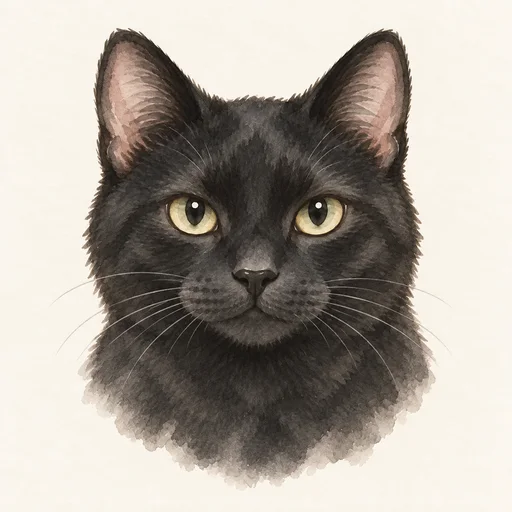
Somewhere along the way, a cat with a coat like polished obsidian got a reputation it never asked for. Black cats have been blamed for storms, witchcraft, and the occasional ruined Tuesday — all for the crime of walking across a path. If you share your home with one of these velvet shadows, you already know the truth: the scariest thing they do is knock a pen off the desk at 3 a.m. and stare at you with glowing eyes while doing it.

Let’s clear the air. Because black cats might just be the most misunderstood, most affectionate, and most quietly wonderful companions in the whole feline lineup — and the folklore that follows them around is more fascinating (and more flattering) than you’d expect.

Where the “bad luck” story actually came from

The bad-luck reputation isn’t ancient wisdom; it’s medieval anxiety. During the witch trials of the Middle Ages in parts of Europe, black cats got tangled up in fears about witchcraft, mostly because they were common companions to the lonely older women who were so often accused. A cat sitting quietly by the fire became “evidence.” It’s a grim origin, and none of it had anything to do with the cats themselves.

That superstition sailed to colonial America and stuck around in pop culture — Halloween decorations, spooky-movie shorthand, the whole aesthetic. But here’s the thing about folklore: it’s regional, and it contradicts itself constantly. What one culture called an omen, another called a blessing.

In much of the world, they’re actually lucky

Pull back from the Western horror-movie version and the picture flips entirely:

  • Japan treats black cats as bringers of good fortune, and single women were once said to attract more suitors by keeping one. The beloved maneki-neko “beckoning cat” even comes in black to ward off evil spirits.
  • Scotland holds that a strange black cat arriving at your door signals coming prosperity.
  • Britain, in many regions, considers a black cat crossing your path good luck — and sailors’ families kept them home to guarantee a safe return.
  • Ancient Egypt revered all cats, dark-coated ones included, associating them with the goddess Bastet and treating them as sacred protectors of the home.

So the next time someone tells you a black cat is unlucky, you can gently inform them they’re simply standing in the wrong country.

What black cats are actually like

Here’s where the real story gets warm. Ask people who live with black cats and the same words come up again and again: affectionate, mellow, chatty, a little goofy, deeply loyal. Many owners describe their black cats as velcro companions — the type to follow you room to room, curl into the warm dent you just left on the sofa, and headbutt you awake with sincere devotion.

There’s a lovely bit of lore among cat folks that black cats are more relaxed and people-oriented than average, and while that’s anecdote rather than laboratory finding, it’s a remarkably consistent anecdote. If you’ve ever met a black cat who flops belly-up the moment you walk in, you understand.

That gentle, tuned-in temperament often reads as one of the quieter, more sensitive cat personalities — the sort we’d nudge toward types like The Silent Guardian (INFJ) or The Gentle Soul (ISFP): intuitive, emotionally present, watchful in a soft way rather than a demanding one. If your black cat seems to know when you’ve had a hard day and arrives to sit on your chest accordingly, you’re not imagining the attentiveness.

Curious which of the 16 types your own shadow-cat leans toward? You can take the test and find out, or start with the friendlier walkthrough over at what cat am I.

The mystery is a feature, not a warning

Part of the black cat’s charm is the sense of the unknowable. Their expressions are harder to read — those dark faces hide the subtle whisker and brow cues that give tabbies away — so they come across as serene, composed, faintly enigmatic. In dim light they melt into the furniture and reappear like a magic trick. Their eyes, whether gold, copper, or green, glow against all that black like tiny lanterns.

This “mysterious” quality is exactly what devoted owners adore. A black cat feels a little like sharing your home with a small, purring secret. There’s nothing sinister about it — it’s just that beauty plus a poker face reads as depth. And honestly? It usually is depth. These are observant, thoughtful animals who watch the household with quiet interest.

Let’s talk about “black cat bias”

Here’s the part that matters most, and the reason this myth is worth busting out loud.

Black cats and kittens are consistently among the last to be adopted from shelters and rescues, and among the most likely to wait the longest for a home. The reasons are a tangle of the superstitions we just walked through, plus some plainer, sadder ones:

  • They photograph poorly in bright shelter lighting, so their adoption listings don’t pop the way a calico or orange tabby does — a real problem in an age when adoption starts with a phone screen.
  • There are simply a lot of them — black is a genetically dominant, common coat — so they blend together in a crowded cattery.
  • Lingering “spooky” associations make some adopters hesitate without quite knowing why.

None of these are the cat’s fault, and none of them reflect a single thing about how loving these animals are. A black cat overlooked in a shelter is not a lesser cat. It’s a wonderful cat waiting for someone to look past a myth.

Coat color and personality: the honest science

Now, a friend owes you honesty, so here it is: there is no solid scientific proof that coat color determines personality. The idea that black cats are uniformly mellow, or that orange cats are uniformly wild, is folklore dressed up as fact. Some studies have explored owner perceptions of color and temperament, but perception is a slippery thing — we notice what we expect to notice, and a “sweet black cat” story spreads faster than a “perfectly ordinary black cat” story.

What genuinely shapes a cat’s personality is a richer mix: genetics beyond the color gene, early-life socialization, the temperament of the parents, and the environment they grow up in. A kitten handled gently and often in its first weeks tends toward confidence and friendliness regardless of what color it turns out to be. If you’re curious how we actually think about feline temperament — and why we lean on behavior rather than fur — our methodology page lays out the four behavioral dimensions we score.

So when we call black cats affectionate, hold it lightly: it’s a beloved pattern in the community, not a genetic destiny. The individual cat in front of you is the only reliable authority on the individual cat in front of you.

Why you should adopt one anyway

Everything we’ve covered lands in the same happy place. Black cats are gentle, devoted, beautiful, and — through no fault of their own — overlooked. That combination makes adopting one feel a little like being let in on a secret the rest of the world keeps missing.

If you’re considering it, a few gentle notes:

  • Meet the cat, not the coat. Spend ten minutes in a room with a black cat and let its personality — not the color — tell you who it is.
  • Give the shy ones a beat. A cat that seems reserved in a loud shelter often blossoms into a shameless cuddler once it’s home and calm.
  • Take a lot of photos in good light. You’ll spend the rest of your life trying to capture how gorgeous they are, and failing adorably. It’s part of the fun.

You can read more about these midnight-coated sweethearts on our black cat breed guide, and if you already have one curled against you as you read this, consider running the personality test together. Every black cat is a small, warm argument against an old, tired myth — and the only luck they’ll bring you is the good kind.

Cat types in this article

Related breeds

Meet your cat's personality type

Take the free 16-question PurrJung test — about 3 minutes to discover which of the 16 feline types your cat is.

Take the Free Test
Copied!