Why Does My Cat Follow Me Everywhere?
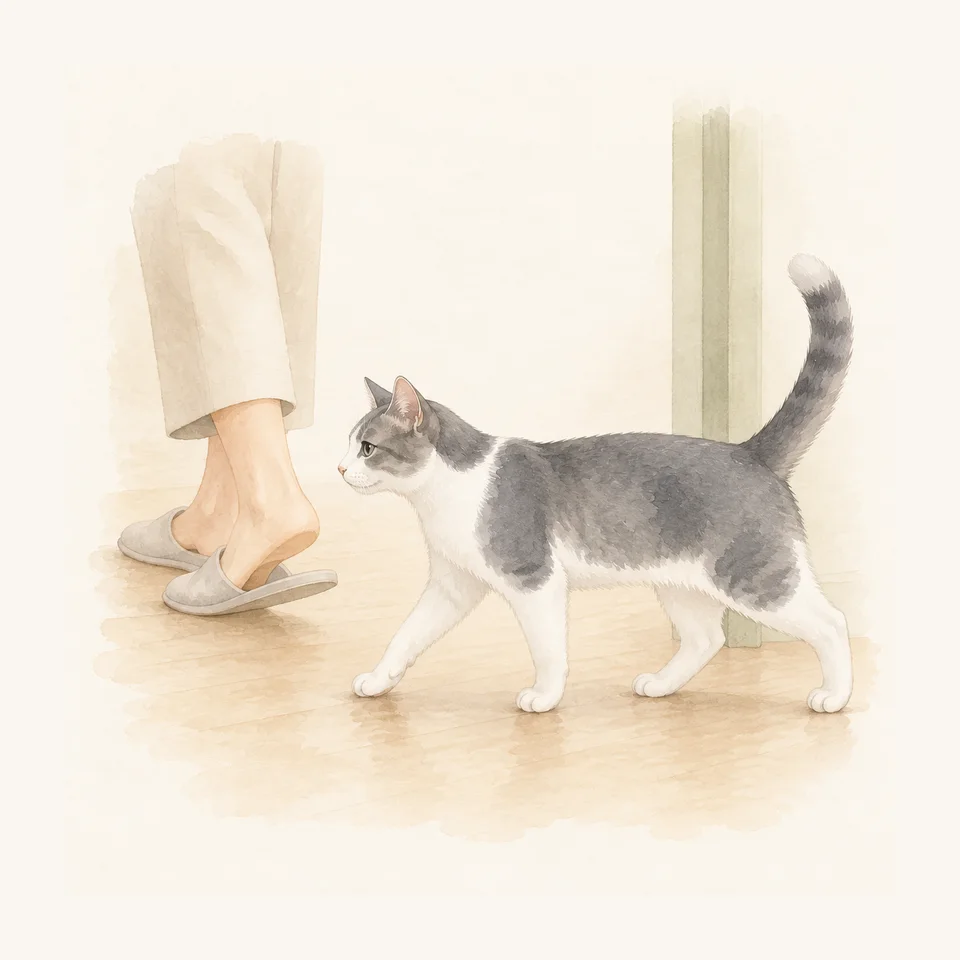
You stand up to get a glass of water, and there they are: four soft paws padding behind you across the kitchen tile. You round the corner to the laundry room, and a little face peeks around the doorframe like you might be up to something exciting without them. Sound familiar? If your cat has appointed themselves your personal shadow, you are not imagining it, and you are definitely not alone.
The good news, right up front: a cat who follows you everywhere is usually telling you something lovely. But the why underneath it is more interesting than “my cat is clingy,” and understanding it can deepen the bond you two already share.
They’ve decided you’re their favorite thing
Cats are often sold to us as aloof little roommates who tolerate our presence in exchange for kibble. Anyone who actually lives with one knows better. Cats form real, specific attachments, and when your cat trails you from room to room, they are casting a vote: out of everything in this home, you are the most interesting.
This is genuine social bonding. Your cat associates you with warmth, safety, food, play, and that spot behind the ears that makes their eyes go half-moon. Following you keeps them near the center of all the good things. In a very real sense, you’ve become their home base, the fixed point they orbit around.
Some cats are just built to shadow you
Here’s where it gets fun. Not every cat follows their human, and the ones who do tend to share a certain temperament. Just like people, cats sit somewhere on a spectrum from independent and self-contained to deeply social and people-oriented.
Cats who lean toward the warm, loyal, attentive end of that spectrum are your classic shadows. They want to be where you are. They read the room, notice your moods, and quietly position themselves nearby. If you’ve ever taken the free cat personality test and landed on a caretaker-type result, you probably already know exactly the cat we mean.
The types most likely to become your devoted little sidekick include:
- The Loyal Companion (ISFJ) — steady, gentle, and happiest curled somewhere they can keep a quiet eye on you.
- The Warm Host (ESFJ) — sociable and affectionate, they treat your presence like the main event of the day.
- The Devoted Guardian (ENFJ) — emotionally tuned-in cats who seem to sense when you need company.
Curious where yours lands? You can find out what cat you have and see whether the shadowing habit lines up with their type. Our scoring methodology breaks down the four behavioral dimensions we use, and the social ones — how outgoing they are, how attuned they are to feelings — are exactly the traits that turn a cat into a full-time follower.
The resource manager
Let’s be honest about a slightly less romantic motive too: you are the source of everything. The food appears because of you. The treat drawer opens because of you. The door to the sunny bedroom gets opened because of you.
Smart cats figure this out fast. Following you around is, partly, strategic. They’re keeping tabs on the being who controls the good stuff, ready to materialize the instant a can opener whirs or a bag crinkles. This isn’t cynical — it sits right alongside genuine affection. Your cat can adore you and keep a professional interest in your proximity to the kibble. Both things are true.
Kittenhood never really left
If your cat was orphaned young, bottle-fed, or separated from their mother a little early, they may have imprinted on you as their parent figure. Kittens follow their mothers constantly — it’s a survival instinct, a way of staying safe and learning how the world works.
A cat who missed some of that early feline mothering often transfers the whole program onto their human. You become mom, and following you everywhere is simply what a kitten does. This is especially common in hand-raised cats and certain gentle, people-bonded breeds like the famously velcro Ragdoll, who tend to attach hard and stay attached for life.
Routine, patrol, and “supervising”
Cats are creatures of ritual. They learn the rhythm of your day with startling precision — when you wake, when you make coffee, when you settle onto the couch — and they like to be present for the transitions. Following you as you move through the house is a way of tracking the day’s schedule and staying oriented.
There’s also a territorial thread here. To your cat, the home is a shared domain, and you moving from room to room is worth monitoring. Some behaviorists gently call this “supervising” — your cat isn’t just tagging along, they’re overseeing operations, making sure the human is doing the human things correctly. It’s equal parts companionship and quality control.
The great bathroom mystery
And now, the question every cat owner eventually asks: why the bathroom? Why does the closed door drive them to sit outside crying, and why do they insist on joining you at your most private moments?
A few reasons, all of them very cat:
- A closed door is an outrage. Cats dislike being shut out of any part of their territory. The bathroom is the one room we routinely close, which makes it maddeningly mysterious and therefore irresistible.
- You’re a captive audience. For a few minutes, you are sitting still, at their level, not looking at a screen or a stove. Prime petting conditions.
- Running water is fascinating. The faucet, the flush, the general water theater — endlessly entertaining.
- It’s togetherness. In their eyes, you wandered off alone into a small room. Naturally they came to keep you company.
So no, it’s not personal in the way it feels. It’s just that closed doors and quiet moments are exactly the sort of thing a bonded cat cannot abide missing.
When following might mean something more
Most of the time, a shadow cat is a happy, well-attached cat, and there’s nothing to fix. But occasionally the behavior tips over into something worth a gentle second look, especially if it’s new or intense.
Keep an eye out if the following comes with:
- Constant, anxious vocalizing when you’re out of sight, or distress the moment you leave a room.
- Destructive behavior, over-grooming, or accidents when you’re away — possible signs of separation anxiety.
- A sudden change in a previously independent cat, which can occasionally point to discomfort, pain, or declining eyesight or hearing in older cats. When in doubt, a vet visit rules out the medical stuff.
- Following paired with excessive neediness that seems driven by stress rather than affection.
If any of that rings true, a few gentle adjustments can help your cat feel more secure on their own:
- Build in reliable daily play and feeding routines so the day feels predictable.
- Create cozy, elevated safe spots — a window perch, a warm bed near a sunny wall — where being alone feels good, not scary.
- Rotate puzzle feeders and toys to give their brain something to do when you’re busy.
- Practice calm, low-drama departures and arrivals. No big goodbyes, no frantic reunions — you want leaving and returning to feel unremarkable.
The short version
For the vast majority of cats, the room-to-room escort service is exactly what it looks like: love, trust, curiosity, and a healthy interest in your snack cabinet. You’ve become the sun their little world revolves around, and honestly, that’s one of the sweetest compliments a cat can pay you.
So the next time you look down and find a devoted furry companion staring up at you in the bathroom doorway, take it as the quiet, four-pawed “I choose you” that it is. And if you want to understand why your particular cat is such a determined shadow, getting to know their personality type is a lovely place to start.
Cat types in this article
Related breeds
Meet your cat's personality type
Take the free 16-question PurrJung test — about 3 minutes to discover which of the 16 feline types your cat is.
Take the Free Test