THE PURRJUNG FIELD GUIDE · FELINE ANATOMY
Skeleton & joints
Over two hundred spring-loaded bones, a supple spine, and floating collarbones built for quiet leaps
Sources checked ·
An educational anatomy guide for cat caregivers. It cannot diagnose illness, interpret lab results, or recommend medications or doses; individual care decisions belong with a veterinarian.
Signs that cannot wait- Anatomical terms
- Axial & appendicular feline skeleton (~230–250 bones)
- Where it sits
- Full body frame: skull, spine, tail, ribcage, forelimbs, pelvis, and hindlimbs
- Distinctly feline
- A cat’s collarbones float freely inside chest muscle instead of attaching solidly to the shoulder and breastbone, letting cats slip through head-sized gaps and cushion landings smoothly through their forelimbs.
- Everyday job
- Frames and protects internal organs, turns hindlimb muscles into springy leaps, steers midair balance with the tail, and absorbs landings softly.
Where it sits in the body
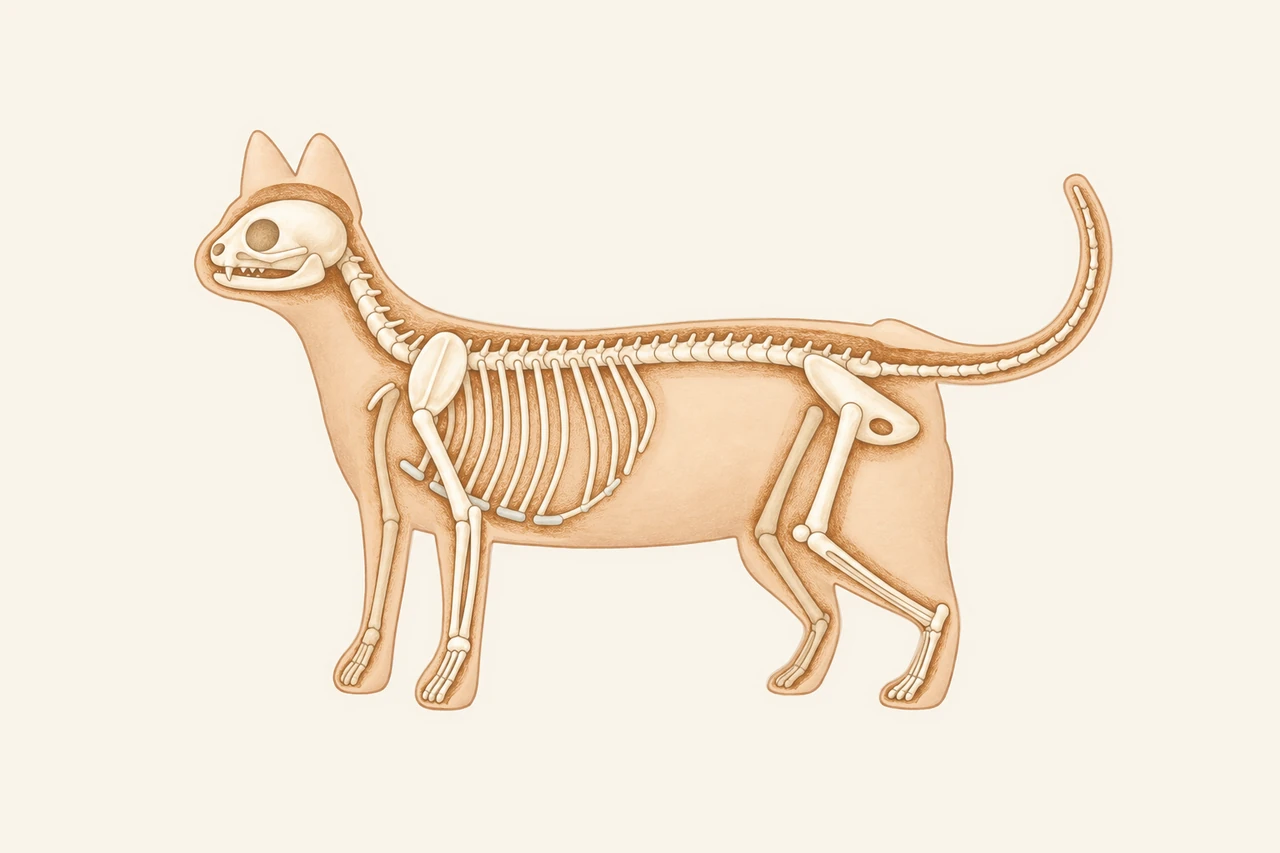
- Skull
- Spine
- Tail vertebrae
- Ribcage
- Forelimb
- Pelvis & hindlimb
The central axis runs from the rounded skull—housing large eye sockets and strong jaw hinges—down a remarkably supple S-curved spine through the ribcage and out into flexible tail vertebrae.
Behind the arched ribs, the pelvis joins strong thigh, stifle (knee), and long hock bones for launch power; up front, broad shoulder blades glide smoothly alongside the chest to cushion every landing.
Neighboring organs & parts
What it does every day
- 01
Coiling and extending the spine like a spring
Cushioned discs and loose spinal ligaments let a cat arch high during a stretch, twist smoothly to groom its own back, and lengthen its stride at a run.
- 02
Protecting chest organs while freeing the shoulders
The curved ribcage shields lungs and heart without locking the front legs rigid, thanks to tiny floating clavicles nestled softly in muscle.
- 03
Launching high and landing softly
Deep pelvic angles and springy hock tendons power upward jumps onto bookshelves, while flexible wrists, elbows, and shoulders soak up shock on the way down.
What to notice at home
Select or scroll past each clue to highlight the matching parts on the plate.
- Skull
- Spine
- Tail vertebrae
- Ribcage
- Forelimb
- Pelvis & hindlimb
Instead of sailing straight onto the kitchen counter or windowsill, a cat with sore hips, stifles, or lower back may pause, measure the height, or hop onto a chair halfway first.
Because forelimbs and shoulders absorb heavy downward landings, front-leg or elbow discomfort often shows up as cautious step-by-step descents rather than upward leaps.
When spine or tail-base joints feel stiff, twisting around to wash becomes uncomfortable—leaving flaky dander, parted fur, or tangled mats along the rump.
Cats rarely yelp or limp noticeably with chronic joint wear. Look instead for sleeping on lower cushions, playing in shorter bursts, or stepping carefully into a high-sided litter box.
With your veterinarian
Short home videos of your cat trotting, climbing stairs, or pausing before a favorite perch are hugely helpful because nervous cats often freeze or move tensely on a slick clinic exam table.
Never give human pain relievers—even tiny doses can be toxic to cats. Ask your veterinarian about safe joint assessments, X-rays, and comfortable home setups like pet steps and low-entry litter boxes.
Signs that cannot wait
- Sudden inability to bear weight on a leg, dangling paw, or acute dragging of both hind legs
- Severe crying when lifted, sudden back paralysis, or a fall from a window or balcony
- Visible swelling, open wound over a joint, or sudden collapse
Sources and limits of this atlas
Sources checked · · Source in English