THE PURRJUNG FIELD GUIDE · FELINE ANATOMY
Bladder & urethra
An elastic storage pouch and exit channel where small shifts demand fast attention
Sources checked ·
An educational anatomy guide for cat caregivers. It cannot diagnose illness, interpret lab results, or recommend medications or doses; individual care decisions belong with a veterinarian.
Signs that cannot wait- Anatomical terms
- Urinary bladder, trigone & feline urethra
- Where it sits
- Lower rear abdomen just ahead of the pelvis, draining backward through the pelvic canal
- Distinctly feline
- A male cat’s urethra makes a tight curve and narrows sharply toward the tip—which is why tiny crystals, mucus plugs, or swelling can block urine flow completely in males while remaining far rarer in females.
- Everyday job
- Collects steady drops of urine arriving from the kidneys, stretches comfortably without leaking, and relaxes smoothly to empty in the litter box.
Where it sits in the body
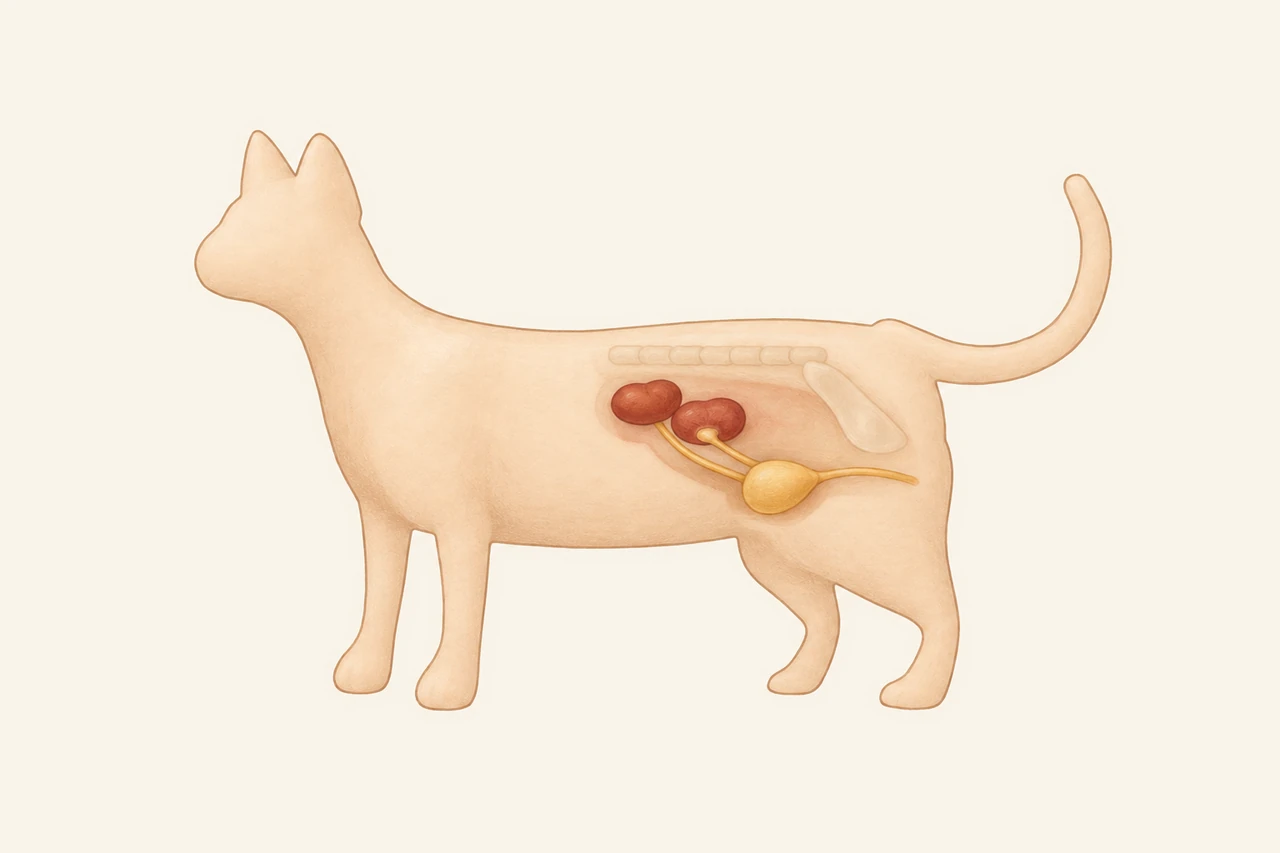
- Kidneys
- Ureters
- Bladder
- Urethra
The pear-shaped urinary bladder rests in the lower rear belly just in front of the pelvic bones, expanding gently forward as urine arrives down the two ureters.
Its narrow neck funnels backward into the urethra, passing through the pelvis to exit—surrounded by calm involuntary muscle that stays closed between trips to the box.
Neighboring organs & parts
What it does every day
- 01
Storing urine safely at low pressure
Smooth elastic muscle stretches outward as urine enters, keeping pressure low so urine never backs up toward the delicate kidneys.
- 02
Protecting delicate lining from sharp wastes
A slick glycosaminoglycan barrier coats the inside of the bladder wall, shielding sensitive nerve endings from concentrated salts and acids in feline urine.
- 03
Coordinating clean, complete emptying
When your cat squats in a quiet box, the bladder wall squeezes smoothly while the urethral sphincter relaxes so urine flows out without straining.
What to notice at home
Select or scroll past each clue to highlight the matching parts on the plate.
- Kidneys
- Ureters
- Bladder
- Urethra
Inflamed bladders feel urgent even when nearly empty—leading to marble-sized litter clumps, repeated trips back to the box, or seeking cool tiles, sinks, or soft laundry.
If mucus, crystals, or spasm plug the narrow male urethra, urine cannot escape at all. Waste builds in the blood within hours—never wait overnight to see if it clears.
Watch for anxious pacing in and out of the box, squatting silently for long minutes, vocalizing, excessive grooming near the tail base, or pink-stained litter.
Idiopathic cystitis (often stress-linked), bladder stones, and bacterial infections look virtually identical at home—and urgent obstruction can back pressure up toward the ureters and kidneys.
With your veterinarian
Always note whether ANY urine is coming out; a veterinarian gently checks bladder size and runs urinalysis, X-rays, or ultrasound rather than assuming an infection by guesswork.
At home, generous fresh water, wet food, and clean low-stress litter boxes in quiet spots help keep urine diluted and comfortable.
Signs that cannot wait
- Straining or crying in the litter box with only drops—or zero urine—coming out (immediate emergency)
- Frequent unsuccessful trips to the box paired with hiding, vomiting, or a firm, tender lower belly
- Visible blood clots in urine or sudden collapse
Sources and limits of this atlas
Sources checked · · Source in English